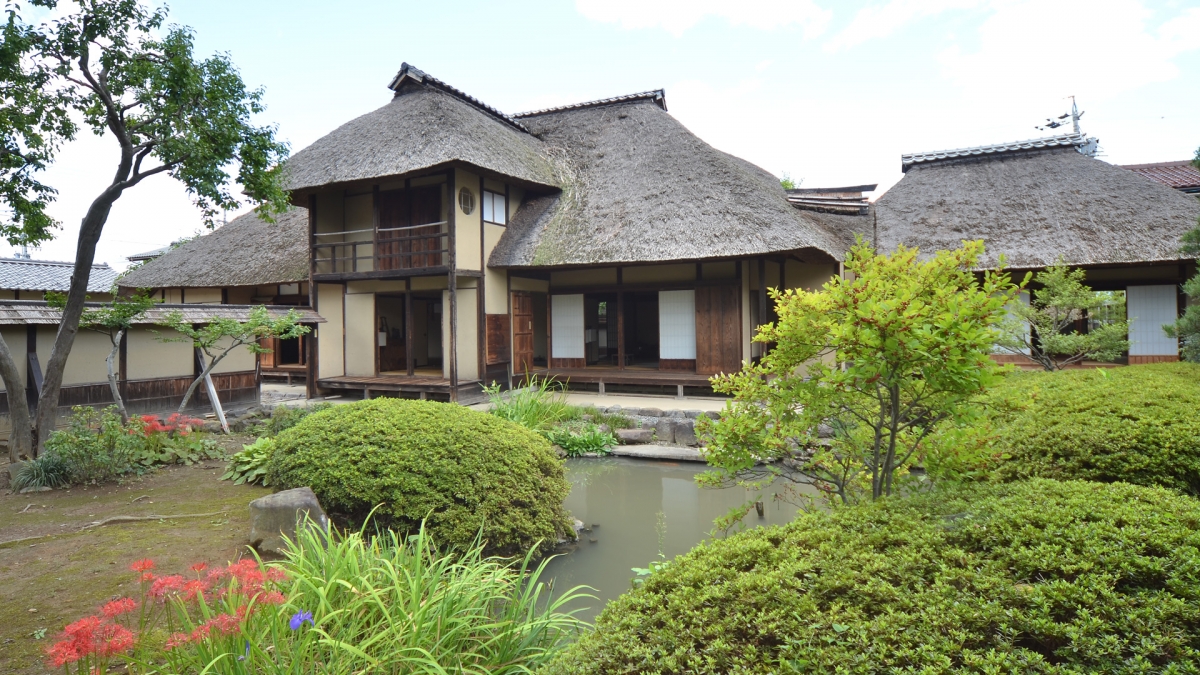
The former Yokota Family Residence was built in the first half of the nineteenth century. This residence belonged to a typical middle-class samurai family who lived in the Matsushiro castle town during the feudal era. Within its premises are a thatch-roofed main building, a house for the retired family head, a traditional warehouse, a pond and a vegetable farm. It is nationally designated an Important Cultural Property as it retains the structures and the site in their original state.
Nagaya Gate
A large gate that extends from one side of the long wall to the other. The Nagaya Gate is one type of gate that houses samurai residences.
As the name implies, it was used as a row house by vassals and servants.
Since the 19th century, a great number of people have come from the Yokota household. Ei Yokota (Ei Wada after marriage), studied silk production at Tomioka Silk Mill (World Heritage Site) in what is now Gunma Prefecture, then instructed others in those techniques when she returned to Matsushiro.
She became a leading figure in the women’s social movement.
People including the Meiji period’s minister of railways, Kenjiro Komatsu, and the chief justice, Hideo Yokota, also came from that household.
Annex for the Retired Master
This rather compact annex is the one used by the retired master of the household.
The layout is similar to the modern houses for two generations of families.
Items grown in this field were used in the home. Having their own field was also a unique trait of samurai properties in the Matsushiro Castletown. Even now, children in the neighborhood use it to grow sweet potatoes. It is also used to grow cotton, indigo, and safflower for use in workshops.
The field covers 1,600 m2, approximately half of the property’s area.
 Former Yokota Family Residence